Donegal Studies - History of Donegal - Landlords of Donegal
Landlords of Donegal
Many of the families who owned the major portion of the land in Donegal right up to the end of the 19th century could trace their presence in the county to the first half of the 17th century, to the Ulster Plantation and the Cromwellian settlement, amongst them the Murrays of Broughton, the Conynghams, and the Brookes. The whole of South West Donegal along with some of the bets land in the county in former Magh Eine, now known as the northern part of the Barony of Raphoe was set aside for Scottish settlers, while the southern part of Raphoe Barony was given to English settlers. The northern third of the Cenel Chonaill territory, now known as the barony of Kilmacrennan was left for servitors and native Irish.
Following the defeat of the O’Donnells in the first decade of the 17th century no time was lost in dividing up their lands through the Plantation. Donegal Castle was given to Sir Basil Brooke, an officer in the English Army, along with the older castle at Lough Eske and the precincts of Donegal Friary. The castle as one sees it today is in essence Brooke’s castle, with only the tower reminding us of the O’Donnells. The O’Donnell lands around Ballyshannon were given to Sir Henry Folliott, the captain of the English garrison in the town. Interestingly Lughaidh Ó Cléirigh, the biographer of Aodh Ruadh, was allowed to keep the Ó Cléirigh hereditary lands until 1609, but this was only a short reprieve; "being a mere Irishman and not of English descent or surname " he was dispossessed at the end of that year.
The Brookes, unlike their relations in neighbouring Fermanagh, did not use the grant of land to build a local empire. The Brookes also failed to emulate other major landowners in the county who were to retain their lands until the Land Acts of the late nineteenth century brought an end to the Irish landlord system; the major part of the land in the south of the county was held right through the eighteenth and nineteenth centuries by three main families: the Murray of Broughton, the Conollys and the Conynghams.
One George Murray of Broughton, in South West Scotland was one of a group of Scotsmen who received much of the the land in the South west of the county. By 1618, however, these were forfeit, and the Baronies of Banagh and Boylagh were granted to a relation of his, John Murray from Cockpool, created Earl of Annandale in 1624. The Murray of Broughtons got the land back in the 1660s, after a longrunning and complex legal dispute. The Murray of Broughton or Murray Stewart Estate, between Donegal, Ardara and Killybegs covered large parts of the parishes of Killaghtee, Killymard, Killybegs, Kilcar and Inishkeel, and totalled about 65,000 statute acres.
In addition to Murray of Broughton Estate there were the Conollys who owned the town and parish of Ballyshannon as well as pockets of land elsewhere in Donegal - east of Donegal Town, part of Killybegs Town, and the southern part of Sliabh Liag - and in between the Marquis of Conyngham who owned most of the land from Mountcharles and Inver up to the Rosses. The most famous member of this family was William 'Speaker' Conolly, the Speaker of the Irish House of Commons 1715-1729 who built the palatial Castletown House in Co. Kildare using revenues gathered from his Donegal Estates.
At the time of the Plantation the lord deputy of Ireland Sir Arthur Chichester was granted 170,000 acres in Inishowen [in 1610], in effect taking over all of the O'Doherty lands following the killing of Cathaoir Ó Dochartaigh in 1608. The English authorities hoped that Chichester would do for this part of Ireland what Richard Boyle had done for his similar sized estates in Cork and Waterford, introducing English tenant farmers, building and sustaining Protestant towns such as Bandon or Youghal. This did not happen, although Derry matured into a sizeable and relatively prosperous city. Chichester sublet to energetic and ambitious English soldiers, such as the Henry Hart, Henry Vaughans and George Cary, whose successors retained much of Inishowen for almost four centuries. Joyce Cary, the 20th century writer, is descended from the Carys who were granted a lease in the Redcastle area soon after the Plantation.
In the north of the county the Earls of Leitrim were one of the major landowners, and the 3rd Earl of Leitrim has, along with John George Adair, gone down in history as an example of the wrong sort of landlord. Other prominent landowners included Wybrant Olpherts a Dutch officer in Cromwell's army, the Stewarts in the Letterkenny and Ramelton area, the Duke of Abercorn in the north-east of the county, and in the early 19th century Lord George Hill.
Lord George Hill has generally been regarded as a 'good' reforming landlord, yet there was a chasm in understanding between Hill and his tenants. Hill was a junior member of the Hill family who gave their name to Hillsborough in Co. Down, and bought his property in Gaoth Dobhair between 1838 and the early 1860s, leaving him with a landholding of 24,189 acres or 55% of the parish.
In 1856, less than a decade after the Famine, a group of men, under the banner of the Molly Maguires, raided the house of James Lillico, a Scotsman who worked as a shepherd in the townland of Altan near Dunlewey. They were protesting at the spread of sheepgrazing in Gaoth Dobhair or Gweedore which was driving local tenants off the land, according to the Daily Express at the time "like the American Red Men". This was the first action in what became known as the 'Gweedore Sheep War'. The smallholders in the area faced ruin both because of the loss of what good land there was in the area to grazing, and to the imposition of police taxes. The Sheep War happened on the cusp of the old and new worlds. The outrage of local people at what was happening was due at least partly to a view of land as not being private property, but as being a communal resource, yet they had to resort to a form of modern organised resistance, similar to trade unionism, to fight it. While the smallholders paid a heavy price, by 1860 their resistance could be said to have been successful, with most of the sheepgraziers gone from the area.
The events in Gaoth Dobhair were eclipsed a year later when John George Adair, the landlord of the Glenveagh estate, and builder of Glenveagh Castle, evicted forty seven families from their smallholdings in Derryveagh. In November of the previous year Adair’s steward, James Murray, was murdered in an isolated part of the estate near Glenveagh Cottage. Murray was, according to a local magistrate, a "violent and hard-tongued man", and had no shortage of enemies. His murderer was never brought to justice, but Adair, alleging a conspiracy amongst his tenants, used the killing to evict his tenants. The scene was covered by local and national papers, the Londonderry Standard recording
" The first eviction was one particularly distressing, and the terrible reality of the law suddenly burst with surprise on the spectators . . . Long before the house (of a widow named McAward) was reached loud cries were heard piercing the air, and the figures of the poor widow and her daughters were observed outside, where they gave vent to their grief in strains of touching agony. "
One hundred and fifty of the people walked to Dublin where they were to take ship to a new life in Australia. A number of relief funds had been set up in Sydney and Melbourne some years earlier to help Irish emigrants to come to Australia. Some of the descendants of victims of the Derryveagh evictions have been traced, and a group of them visited the area in the early 1990s.
The landlords of the south of the county come out of the Famine better than many of their compatriots throughout Ireland, or indeed in the north of the county. Few of them earned the respect of their tenants as did John Hamilton of Brownhall, a large estate south of Donegal Town on the shores of Donegal Bay. Hamilton, "this recklessly generous landlord" as a recent biographer calls him, had around 1,200 tenants on his Brownhall lands, with a further 1,100 on the other side of the Croaghs in Glenfin. The name ‘Brownhall’ seems to have come from the family’s original home of Broomhill in Lanarkshire. The Hamiltons trace their line from Gilbert of Hamildone, and were related by mariage to the Stuarts, the royal line of Scotland.
John Hamilton’s concern for his tenants from the time he inherited the estate in 1821 until his death in 1884 was well recognised during his life. As early as 1841 Fr. Eugene McCafferty wrote that he hoped "that the Lord may grant you happy and lengthened days here among a people to whom you are and always have been so useful". His successor as parish priest of Donegal and noted opponent of landlordism, Fr. John Doherty, wrote, a few years before Hamilton’s death that "his many social virtues, the kindliness of his disposition, and the natural warmth and goodness of his nature have endeared him to his tenantry". Hamilton himself claimed that not a single one of his tenants had to go to the Workhouse, and only one died of starvation. Perhaps the most eloquent testimony to how his tenants felt about him is the causeway to St. Ernan’s island, where his house was located, built by them as a token of their esteem.
Tuesday, May 26, 2009


McElhone's from Dungannon Northern Ireland
Descendants of Phelim Mcelhone
Generation No. 1
1. PHELIM1 MCELHONE was born Abt. 1750 in Dungannon, Co Tyrone, Ireland.
Notes for PHELIM MCELHONE:
Information on this line provided by Michael Tessmer, DNS of Ohio. Research on some of earlier family done by Jim Cullen, a cousin of Michael.
Children of PHELIM MCELHONE are:
i. MICHAEL2 MCELHONE, b. Abt. 1780, Dungannon, Co Tyrone, Ireland; d. Dungannon, Co Tyrone, Ireland; m. ANNE.
Notes for ANNE:
Buried in Donaghmore Cemetery Grave 259
2. ii. FELIX MCELHONE, b. 1782, Dungannon, Co Tyrone, Ireland; d. January 23, 1864, Dungannon, Co Tyrone, Ireland.
Generation No. 2
2. FELIX2 MCELHONE (PHELIM1) was born 1782 in Dungannon, Co Tyrone, Ireland, and died January 23, 1864 in Dungannon, Co Tyrone, Ireland. He married ANNE KELLY.
Notes for FELIX MCELHONE:
Buried Grave 258 Donaghmore Cemetery
From Death Index - Died Dungannon registered vol 1 page 412 1864 age 82 (born 1782)
Children of FELIX MCELHONE and ANNE KELLY are:
3. i. THOMAS3 MCELHONE, b. Abt. 1810.
4. ii. FELIX MCELHONE, b. 1809, Dungannon, Co Tyrone, Ireland; d. April 16, 1875, Dungannon, Co Tyrone, Ireland.
iii. TERENCE MCELHONE, b. Dungannon, Co Tyrone, Ireland; d. January 9, 1854, Dungannon, Co Tyrone, Ireland.
iv. JOHN MCELHONE, b. Dungannon, Co Tyrone, Ireland.
Notes for JOHN MCELHONE:
Present at death of his father per death cert. 1864.
v. JAMES MCELHONE, b. Dungannon, Co Tyrone, Ireland.
Notes for JAMES MCELHONE:
James Godparent with Elizabeth McGettrick, of James son of Felix and Catherine, 1849
vi. SARAH MCELHONE, b. Dungannon, Co Tyrone, Ireland.
Notes for SARAH MCELHONE:
Both Sarah and James witnesses at wedding of Felix and Catherine McGettrick in 1848.
vii. MARY MCELHONE, b. Dungannon, Co Tyrone, Ireland.
viii. MICHAEL MCELHONE, b. September 11, 1822, Dungannon, Co Tyrone, Ireland.
Generation No. 3
3. THOMAS3 MCELHONE (FELIX2, PHELIM1) was born Abt. 1810. He married MARY CAMPBELL.
Child of THOMAS MCELHONE and MARY CAMPBELL is:
5. i. JOSEPH4 MCELHONE, b. Abt. 1835.
4. FELIX3 MCELHONE (FELIX2, PHELIM1) was born 1809 in Dungannon, Co Tyrone, Ireland, and died April 16, 1875 in Dungannon, Co Tyrone, Ireland. He married CATHERINE MCGETTRICK July 30, 1848 in Dungannon, Co Tyrone, Ireland.
Children of FELIX MCELHONE and CATHERINE MCGETTRICK are:
i. ROSE4 MCELHONE, b. February 18, 1851, Dungannon, Co Tyrone, Ireland; d. February 7, 1939; m. JAMES CULLEN.
ii. MICHAEL MCELHONE, b. January 15, 1851, Dungannon, Co Tyrone, Ireland - Christened.
iii. MARY MCELHONE, b. Dungannon, Co Tyrone, Ireland.
iv. PATRICK MCELHONE, b. 1853, Dungannon, Co Tyrone, Ireland.
6. v. MARTIN JOSEPH MCELHONE, b. September 13, 1868, Dungannon, Co Tyrone, Ireland; d. July 9, 1903, Dungannon, Co Tyrone, Ireland.
vi. ELIZABETH MCELHONE, b. November 29, 1865, Dungannon, Co Tyrone, Ireland1.
vii. JAMES MCELHONE, b. Dungannon, Co Tyrone, Ireland.
viii. WINIFRED MCELHONE, b. Dungannon, Co Tyrone, Ireland.
ix. MARGARET MCELHONE, b. Abt. 1866, Dungannon, Co Tyrone, Ireland.
Notes for MARGARET MCELHONE:
This could be the Margaret with death registered in 1869 age 3 vol 16 page 445, Dungannon
x. JOHN BERNARD MCELHONE, b. 1872, Dungannon, Co Tyrone, Ireland; d. 1894.
xi. CATHERINE MCELHONE, b. Dungannon, Co Tyrone, Ireland.
Generation No. 4
5. JOSEPH4 MCELHONE (THOMAS3, FELIX2, PHELIM1) was born Abt. 1835. He married FLORENCE GILBRIDE.
Children of JOSEPH MCELHONE and FLORENCE GILBRIDE are:
7. i. FELIX5 MCELHONE, b. 1909.
ii. JOSEPH MCELHONE, b. 1911.
8. iii. SHANE MCELHONE, b. October 14, 1914.
iv. THOMAS MCELHONE, b. 1914.
v. PATRICK MCELHONE, b. 1910; d. March 28, 1973.
6. MARTIN JOSEPH4 MCELHONE (FELIX3, FELIX2, PHELIM1) was born September 13, 1868 in Dungannon, Co Tyrone, Ireland, and died July 9, 1903 in Dungannon, Co Tyrone, Ireland. He married MARGARET TIERNEY, daughter of THOMAS TIERNEY and SALLY STEWART.
Children of MARTIN MCELHONE and MARGARET TIERNEY are:
9. i. FELIX5 MCELHONE, b. September 27, 1898.
10. ii. THOMAS MCELHONE, b. May 23, 1900, Dungannon, Co Tyrone, Ireland; d. November 28, 1965.
Sunday, May 24, 2009
Alan Freeman definitive UK Disc Jockey
In 1989, Alan Freeman was 62 and celebrating 30 years in the UK radio business. To celebrate, on Tuesday 31st January 1989, the Daily Mirror featured a centre page spread and photos.
It was archived and now, we bring you the story, lovingly reproduced, here on AIRCHECK, as originally written by Noreen Taylor.
Alan in 1962
'He comes skidding across the BBC carpet, arms waving, smile beaming, kisses: "Hello, darling. Alan. Alan Freeman. Call me Fluff, Uncle Fluff. All the young disc jockeys do." A warm bundle of a man, very cosy and wanting to be liked, is Uncle Fluff. He pulls up a chair and pulls out a pack of cigarettes. "Sixty a day, and I love every one of them. My homeopathic doctor says if I don't stop I'll die by the time I'm 65. Hey, hey, I'm an asthmatic as well, but I've no intention of stopping."
He is 62, three years away from his old age pension, and he is still the definitive disc jockey. Without any strain or pretension, he manages to convey excitement, urgency - the qualities pop music used to have before the mostly bland electronics of the Eighties. And for the past three Sunday lunchtimes, Uncle Fluff has been doing what he does best: reminding us of that excitement.
Radio 1 has been amazed by the reaction to his comeback. Fans from 15 to 50 have packed mail bags and jammed switchboards congratulating it on bringing back 'Pick Of The Pops' - the show Alan Freeman created 27 years ago. Same Alan Freeman, same lines, same jingles, always a punctuation beat between the singles.
"Hello, pop pickers. All right? Stay bright." Naturally old Fluff is enjoying every minute of this comeback to national radio after ten years at London's Capital Radio. "Isn't it incredible?" says he, puffing away, ash cascading down his trousers. "I thought when Radio 1 announced my return, everyone would be moaning 'Oh Christ, not him again.' Instead, I've got all these kids writing in about how they and their mates feel cheated. They wish they'd been born earlier. 'The Sixties were so exciting...Why isn't it like that now?...Had I really met John Lennon? You see, they are discovering a whole new world. Dusty Springfield, The Who, the Motown sound. What can I say? Today's pop is too electronic, too repetitive."
He did say that the sound of Kylie Minogue left him brain-dead. But he loves Whitney Houston and The Pet Shop Boys. There are certain records he won't play, namely those of Des O'Connor & Ken Dodd. "Doesn't mean I'm right, though." he adds, always the diplomat. "Three million people bought Ken Dodd's 'Tears'. But right now, pop music is in a trough. We are waiting for the next buzz, the next craze. Pop always comes up with surprises. That's why I love it as much today as I did when I arrived from Australia in 1957." He had trained to be an opera singer. And the worst moment of his life was when he first heard himself in a recording studio.
Alan says "I knew I hadn't got it. I just wanted to slit my wrists. Instead I did the right thing. I stayed close to music by working as a radio presenter. Then I got the Australian itch to travel to London." He remembers one night in the Fifties, switching on BBC Radio and hearing an announcer tell listeners..."That was Frank Sinatra singing on a gramophone record, and here is another rather nice song." The world of pop radio was wide open for men like Alan Freeman who understood the importance of such new names as Chuck Berry, Elvis and Jerry Lee Lewis. Teenagers, rebellion, rock...a whole new revolution had begun and Alan was in there, at the turntable, close to the heartbeat. First on Radio Luxembourg, then on the Light Programme, the forerunner of Radio 1.
He met, interviewed and became pals with names that have since become legends. The 'Mr. Nice Guy' tag has been earned because he has never gone in for bad-mouthing of selling the sort of secrets that could have made him a fortune. Instead he tells you they were all great people. John Lennon was 'funny', Paul was 'an ordinary man who wanted an ordinary life', Dusty Springfield 'a great talent and a lovely lady.'
Fluff meets .... Lulu Fluff meets.... The Beverley Sisisters
His one great regret was turning down an interview with Elvis. "I couldn't make it to America because of commitments." Then, three years later, Elvis was dead. "I've had a wonderful life. Wonderful. Only thing is, my passion has been spent on my career. I've shirked the responsibility of marriage and children. It would be nice now to have kids to sit around and talk to." He claims that there IS a lady in his life. "I have someone" he says carefully. "Someone who I know will spend the last years with me. She has always remained in the background, but she has always been there for me. So that's all right. Isn't it?"
The moment's seriousness passes as he sticks his head down and invites me to feel his hair. "Papers are always having a go at me, saying Fluff wears a wig. Go on. Feel if you like. That's no wig." No, those carefully teased strands are all his own. "You don't think I'm too old to be doing this do you?" he asks, without wanting an answer. "I wouldn't do it if I wasn't getting a buzz out of it. People are amazed that I'm still jumping up and down asking 'Hey have you heard the latest Def Leppard?' And obviously they want me."
Indeed they do. The controller of Radio 1 said "We want him because quite simply, he is the best." Alan says, "I haven't changed. I'm still running around clubs at night, listening to new bands, waiting for the next sound. I do the Radio 1 rock show from midnight till two on Saturdays, go back to the flat for five hours sleep, wake up, cups of coffee, couple of fags, then I'm back in the studio for ten, preparing for Sunday's show."
His little legs keep tapping up and down, while his arms weave around like windmills. There is something childlike about him. Maybe it's because he is dressed like a 14-year old boy - plimsolls, Adidas sweatshirt over a shirt that's hanging out of his trousers. Alan says: "I suppose I'm a bit like the long lost friend you think has died, and then comes back surprising everyone...or p***ing them off." Not in Uncle Fluff's case. ALL RIGHT? RIGHT. STAY BRIGHT.
Fluff celebrating his return to Radio 1 in 1989 after 10 years at Capital Radio.
Selling Lord George´s House
Thu 06 Jun 2007
Lord it up in Donegal estate for €3 million
Roy Greenslade and his wife Noreen, a descendant of tenants evicted by Lord George Hill, are now selling the landlord's house. Although Lord George Hill died almost 130 years ago he is still a regular conversation topic in his former home, Ballyarr House in Ramelton, Co Donegal, where his portrait is reproduced on a mural in the main hall, writes Fiona Tyrrell."We talk endlessly about old George," says former Daily Mirror editor Roy Greenslade, who has lived in the house with his wife, Noreen Taylor, for the last 18 years.
Tuesday, May 19, 2009
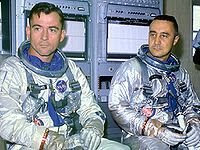
Gemini 3 Molly Brown
Gemini 3 was a 1965 manned space flight in NASA's Gemini program. It was the first manned Gemini flight, the seventh American flight and the 17th manned spaceflight from Earth of all time (includes X-15 flights over 100 kilometers).
Objectives
This first manned flight of the Gemini spacecraft was very much a test flight. In a playful reference to the Broadway hit The Unsinkable Molly Brown, Grissom nicknamed the Gemini 3 spacecraft Molly Brown hoping that it would not duplicate his experience with Liberty Bell 7. It was the last Gemini to be named by an astronaut. All subsequent flights in the program were designated by a Roman numeral.
The mission's primary goal was to test the new, maneuverable Gemini spacecraft. In space, the crew fired thrusters to change the shape of their orbit, shift their orbital plane slightly, and drop to a lower altitude. Other firsts were achieved on Gemini 3: two people flew aboard an American spacecraft (the Soviet Union launched a three-man crew on Voskhod 1 in 1964, upstaging the two-man Gemini and three-man Apollo programs); the first manned re-entry where the spacecraft was able to produce lift to change its touchdown point.
Flight
The only major incident during the orbital phase involved a contraband corned beef sandwich that Young had sneaked on board. The transcript of the crew's conversation during the episode reveals Grissom was unimpressed: (C=Commander Grissom, P=Pilot Young)
01 52 26 C What is it?
01 52 27 P Corn beef sandwich.
01 52 28 C Where did that come from?
01 52 30 P I brought it with me. Let's see how it tastes. Smells, doesn't it?
01 52 41 C Yes, it's breaking up. I'm going to stick it in my pocket.
01 52 43 P Is it?
01 52 49 P It was a thought, anyway.
01 52 51 C Yep.
01 52 52 P Not a very good one.
01 52 52 C Pretty good, though, if it would just hold together.
01 53 13 P Want some chicken leg?
01 53 15 C No, you can handle that. [1]
The crew each took a few bites before the sandwich had to be restowed. The crumbs it released could have wreaked havoc with the craft's electronics, so the crew were reprimanded when they returned to Earth. Other crews were warned not to pull the same type of stunt again.[2]
Launch of the first manned Gemini flightTwo small failures occurred in-orbit. The first was an experiment testing the Synergistic Effect of Zero Gravity on Sea Urchin Eggs. A lever essential to the experiment broke off when pulled. The second involved the photographic coverage objective. It was only partially successful due to an improper lens setting on the 16 mm camera.
Early in the flight there was a minor problem with one of the Orbital maneuvering system thrusters:
00 18 41 C I seem to have a leak. There must be a leak in one of the thrusters, because I get a continuous yaw left.
00 18 53 CC Roger. Understand that you get a continuous yaw left.
00 18 57 C Very slight. Very slow drift. [1]
This is of interest as a similar problem with a stuck thruster in Gemini VIII became much more significant, as Neil Armstrong took some time to regain control of the spinning vehicle. In this mission the problem did not get out of hand, and the thruster was disabled.
The crew made their first orbit change an hour and a half into the flight. The burn lasted 75 seconds and moved them from a 122 by 175 kilometer orbit to a nearly circular one with a drop in speed of 15 metres per second. The second burn was 45 minutes later when the orbital inclination was changed by 0.02 degrees. The last burn came during the third orbit when the perigee was lowered to 72 kilometers. This meant that even if retrorockets had failed, they would still have reentered. When reentry finally occurred, crew commented that even the colours matched ground simulations.
On descent, the capsule shifted from a vertical to horizontal attitude under its parachutes. The change was so sudden that Grissom cracked his faceplate (made of plexiglas) on the control panel in front of him. Later Gemini spacesuits and all Apollo and Space Shuttle (both the launch-entry and EVA suits) used polycarbonate plastic.
The craft landed eventually 84 kilometers short of its intended splashdown point. Wind tunnel testing incorrectly predicted the craft's ability to compensate for course deviation. When the crew discovered the error, they decided to stay in the capsule, not wanting to open the hatch before the arrival of the recovery ship. The crew spent an uncomfortable half an hour in a spacecraft never designed to be a boat. Due to unexpected smoke from the thrusters the crew decided to deviate from the post landing checklist and to keep their helmets on with the face plates closed for some time after splashdown [1]. The USS Intrepid recovered the craft and crew. The Gemini III mission was supported by the following United States Department of Defense resources: 10,185 personnel, 126 aircraft and 27 ships.
Insignia
The mission insignia was not worn by the flight crew as a patch, like those from Gemini 5 onwards. The Gemini 3 Molly Brown logo was designed and minted on gold plated, sterling silver, 1-inch (25-mm) medallions. The crew carried a number of these medallions into space to give to their families and friends. The same design was imprinted on the cover of Gus Grissom's book GEMINI. John Young was seen wearing the Molly Brown logo as a patch on his flightsuit as late as 1981.
Sunday, May 17, 2009
Date your Guild Acoustic
1970-1979
This chart displays the first and last serial numbers of guitars produced each year from 1970 to 1979 (inclusive); no corresponding model names or numbers are available.
YEAR FIRST NUMBER PRODUCED LAST NUMBER PRODUCED
1970 46696 50978
1971 50979 61463
1972 61464 75602
1973 75603 95496
1974 95497 112803
1975 112804 130304
1976 130305 149625
1977 149626 169867
1978 169868 195067
1979 195068 211877 (to Sept. 30, 1979)
Friday, May 8, 2009
Obituary
Death of Local Historian Pat John Rafferty 07/05/2009
Tributes have been paid to popular Donaghmore teacher and local historian Pat John Rafferty who sadly passed away last Tuesday. He was aged 69.
Pat, a loyal GAA follower and amateur dramatist, was born in Carrickmore in 1940. He was educated at St. Patrick's College, Armagh and went on to Queen's University to study History. He began his teaching career in St Helen's Liverpool in 1964 before spending two years in Nigeria.
In 1970 he married. Mary and together they had four children Conor, Elish, Susan and Maeve to who sympathy is extended.
Promoting the rich cultural heritage of Tyrone, he occupied a leading role in a number of organisations including the William Carleton Summer School which was founded in 1992 and the Donaghmore Historical Society which was established in 1983.
Pat, who took up a position at St. Patrick's College, until his retirement in 1997 and his knowledge of local history combined with his talent for public speaking saw him lead tourists on specialised tours in Dungannon, his most recent in the "Return of the Earls Project."
Pat, a Dungannon Civil Rights Activist was also Bernadette Devlin's election agent and as a successful sportsman completed a total of four marathons and picked up a GAA County Championship medal with Carrickmore in 1961. He was also a member of St Patrick's Donaghmore GFC Scor Sinsear team.
Source: Tyrone Courier
Date: Wednesday 6 May 2009
Tuesday, May 5, 2009
Ireland-Afghanistan ??
Places of interest
An interesting feature of the town is the former police barracks at the top right-hand corner of the market square which is quite unlike any other barracks of a similar vintage in Ireland. A popular but apocryphal story relates that the unusual design of this building is due to a mix-up with the plans in Dublin which meant Dungannon got a station designed for the Khyber Pass in Afghanistan and they got a standard Irish barracks, complete with a traditional Irish fireplace.
An interesting feature of the town is the former police barracks at the top right-hand corner of the market square which is quite unlike any other barracks of a similar vintage in Ireland. A popular but apocryphal story relates that the unusual design of this building is due to a mix-up with the plans in Dublin which meant Dungannon got a station designed for the Khyber Pass in Afghanistan and they got a standard Irish barracks, complete with a traditional Irish fireplace.
Dungannon
Dungannon (from the Irish: Dún Geanainn meaning "Geanann's fort") is a town in County Tyrone in Northern Ireland. It is the third-largest town in the county (after Omagh and Strabane) and a population of 11,139 people was recorded in the 2001 Census. In August 2006, Dungannon won Ulster In Bloom's Best Kept Town Award for the fifth time. It contains the headquarters of the Dungannon and South Tyrone Borough Council.
History
Dungannon's fortunes have been closely tied to that of the O'Neill dynasty which ruled most of Ulster until the seventeenth century and was the most powerful Gaelic family. Dungannon was the clan's main stronghold which made it by default the most important settlement in Gaelic Ireland. The traditional site of inauguration for 'The O'Neill', was Tullyhogue Fort,an iron age ceremonial rath some four miles northeast of Dungannon. The clan O'Hagan were the stewards of this site for the O'Neills.The last castle was located at what is today known as Castle Hill; the location was ideal for a fort as it was one of the highest points in Tyrone, and dominated the surrounding countryside with the ability to see seven counties depending on the weather. Its location ultimately led to the Army taking over the site for a security installation during The Troubles, only being returned to the local council in August 2007.
This castle was burned in 1602 by Hugh O'Neill, 2nd Earl of Tyrone as the English forces closed in on the Gaelic lords towards the end of the Nine Years War. In 1608, ninety-nine Irish chieftains and their followers, including Hugh O’Neill, set sail from Rathmullan, Co. Donegal, bound for the continent. What followed became known as the Plantation of Ulster and the town and its castle were granted to Sir Arthur Chichester, the architect of the Plantation.
The castle was partially excavated in October 200, by the Channel 4 show 'Time Team', uncovering part of the moate and walls of the castle.[1]
[edit] After the O'Neills
Dungannon remained the county seat of County Tyrone after the Plantation, but High Court judges who travelled to Dungannon to the courthouse were attacked in the village of Cappagh and the county town was then moved to Omagh[citation needed]. In 1973, the town became the seat of the new district of Dungannon.
In 1782, the town was the location where the independence of the Irish Parliament was declared by members of the Protestant Ascendancy who controlled the parliament at the time.[2]
The Troubles
Dungannon was one corner of the infamous murder triangle during the Troubles. For more information see The Troubles in Dungannon, which includes a list of incidents in Dungannon during the Troubles resulting in two or more fatalities.
Saturday, May 2, 2009
A Man Called Harry Brent
Jacqueline
TX : 29th March 1965
Synopsis : When Carol's employer Tom Fielding is killed by a total stranger, the police, led by Carol's ex-fiance, Alan Milton, find enough evidence to involve her present fiancé, a man called Harry Brent. Naturally, Alan is determined to find out more about him.
TX : 29th March 1965
Synopsis : When Carol's employer Tom Fielding is killed by a total stranger, the police, led by Carol's ex-fiance, Alan Milton, find enough evidence to involve her present fiancé, a man called Harry Brent. Naturally, Alan is determined to find out more about him.
Subscribe to:
Posts (Atom)